Camping across the United States
About Campsite Notebook
About Campsite Notebook
Campsite Notebook is a new, independent publication from SiteLift Media about camping across the United States. It brings campground planning, gear and camp cooking together because the same reservation can affect all three. A walk-in tent site changes what you carry from the car. A campground with no water at the individual sites changes how you set up for coffee, dinner and dishes.
The site is for people booking their first tent site, returning campers trying a different part of the country and anyone planning a few nights outdoors as part of a longer drive. You might be deciding whether two tents fit on one pad, whether a campground works for a late Friday arrival or whether to bring a cooler for one dinner or three.
The scope is recreational camping in the United States, with an emphasis on the details you can use before leaving home. For a desert campground, that might mean finding out whether the sites have shade. For a wooded campground, it might mean comparing the parking and tent areas. A campground can suit the dates you want and still be a poor fit for the way you like to camp.
Choosing a campground and planning the drive
Start with the managing agency’s current campground page. The dates a park is open are not necessarily the dates a particular campground or loop is open. Check when reservations become available and whether the site you want can be booked ahead. If the campground description lists water, find out whether that means a tap at each site, a shared spigot or a service available only during part of the season.
For the drive, look at the approach to the campground as well as the mileage from home. The last few miles may be on gravel even if most of the trip is on an interstate. Look for current descriptions of seasonal access, road surface and grades. If you are comparing sites for a trailer, look at the published parking dimensions as well as the campground’s general description.
The useful comparison is often between two specific sites. One may have parking beside the picnic table while another involves carrying everything down a path. A listing may give a tent pad’s dimensions without telling you much about the space around it. Those distinctions help you decide which details to look up before choosing a site number.
Packing for the campsite you booked
The gear and packing coverage starts with what you expect to do at camp. Group the kit by shelter, sleep, cooking and weather rather than treating every item on a general camping list as essential. At a drive-in site, a separate kitchen bin may be convenient. At a walk-in site, it matters how many trips that bin, the cooler and the bedding add between the car and the tent pad.
Check fit and condition at home while the gear is easy to lay out. Put the sleeping pads next to each other and compare their combined width with the tent floor. Check that the poles in the tent bag belong to that tent and that the fitted lid is in the same bin as the pot. These checks are as applicable to borrowed gear as they are to new purchases.
Pack for the dates and location of the trip rather than the usual weather at home. An evening spent outside at a high-elevation campground can call for different clothing than an afternoon spent loading the car in town. Consider what you will want close at hand when you arrive, whether that is a rain shell near the hatch or a dry layer separate from the clothes you wore on the drive.
Planning the camp kitchen
Start with the meals you expect to eat at the site and the stove, cooler space and cleanup water you can bring. A one-burner breakfast might be oatmeal followed by coffee rather than eggs, toast and coffee served together. For a short weekend, a dinner that uses one pot may suit the trip better than a menu that calls for a skillet and a second saucepan.
Think through the campground setup before choosing how to cook. A fire ring shown in a site photo does not tell you whether cooking over a wood fire is currently permitted. Check the managing agency’s current fire restrictions before planning a meal over flame. Also check what the campground says about dishwater, particularly if the only water listed is a shared tap rather than a dishwashing station.
A camp kitchen kit can be as simple as the cookware, utensils and cleanup items needed for the meals you chose. If dinner is soup and bread, a pot, ladle and bowls may matter more than a full set of pans. If cooler space is limited, compare the room your ingredients take up with the room you also want for drinks and the next morning’s breakfast.
How to use the site
Use Plan a campout to start with the part of the trip you still need to work out. Begin with USA destinations if you are comparing a lakeside campground with one closer to your driving route. Start with Gear & packing if the site is booked but you are unsure what will fit in the car alongside two tents and a cooler. Go to Camp kitchen when the main question is what you can cook with the setup you have.
The field guides connect those decisions. If a destination guide prompts you to check whether the campground has a shared spigot, take the answer into your packing and kitchen plans. A longer carry from a parking area might change which water container you bring. The amount of water you plan to carry might in turn make a one-pot dinner more appealing than a meal that uses several pans.
Trail Notes is the publication’s archive. Use it to return to a guide when a detail of the trip changes, such as switching from a drive-in campsite to a walk-in one. Use the guide for planning context and the managing agency’s current information for details that can change between visits.
The raccoon with the map
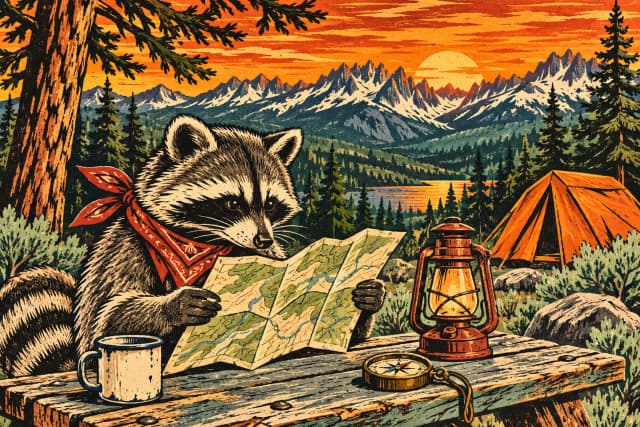
The Campsite Notebook mascot is a raccoon reading a map at a campsite. The raccoon represents curiosity about ordinary camp details. The map represents the planning that makes those details useful, such as finding out whether a site is near the campground entrance, at the far end of a loop or beyond a separate parking area. The illustration puts both ideas in a familiar setting.
The raccoon is reading rather than rummaging through the camp kitchen. That choice keeps the focus on the camper’s questions. Where is the tap relative to the tent site? How far is the walk from the car with a full cooler? The mascot is an illustration, not an account of a wildlife encounter or a claim about what animals you will see at a particular campground.
How the publication is made
Campsite Notebook uses AI assistance in research, drafting and illustration. It also publishes original longer guides that give related decisions room to be discussed together. A longer guide to planning a weekend campout can discuss the campground’s reservation setup, the trip from the pavement to the site and the packing implications of leaving the car in a separate lot.
An illustrated campsite is not documentation of what a specific site looks like, and a gear discussion is not a claim of hands-on testing. For example, an illustration may show a tent beside a table without establishing how much space there is on a numbered pad. Likewise, a discussion of two-burner stoves can explain how the layout affects a meal without asserting that a particular model was used on a trip.
The publication includes affiliate disclosures. If you encounter an affiliate link while reading about a camp kitchen kit, the disclosure explains the affiliate relationship. The packing decision is separate. If you already have a pot that fits your stove and a bin that holds the supplies for your menu, consider those alongside anything mentioned in the guide.
Feeds and corrections
Campsite Notebook has public RSS and Atom feeds. Add either feed to a compatible reader if you prefer to follow the publication there rather than opening the homepage to look for new entries. Trail Notes is the on-site archive if you would rather browse past entries before a trip, whether you are revisiting campsite selection or looking up the packing considerations for a walk-in site.
Use Contact to flag a correction. The guide title or page address and the passage in question help identify the problem. If a guide describes water at every site but the current campground information lists only a shared tap, include the campground and loop if you know them. If a gear passage confuses a tent’s floor dimensions with its packed dimensions, point out which measurement needs attention.
Read our editorial standards or send a question or correction.